PAP Teeth Whitening Explained
What PAP is, why most home whitening kits in the UK and EU use it, what the research says about how well it works, and how it compares with hydrogen peroxide.
What Is PAP?
PAP stands for phthalimidoperoxycaproic acid. It is a whitening ingredient used in many home kits, strips and pens instead of hydrogen peroxide or carbamide peroxide, the bleaching agents used in dentist whitening. Researchers describe it as a non-hydrogen-peroxide whitening agent.
Why UK and EU Kits Use PAP
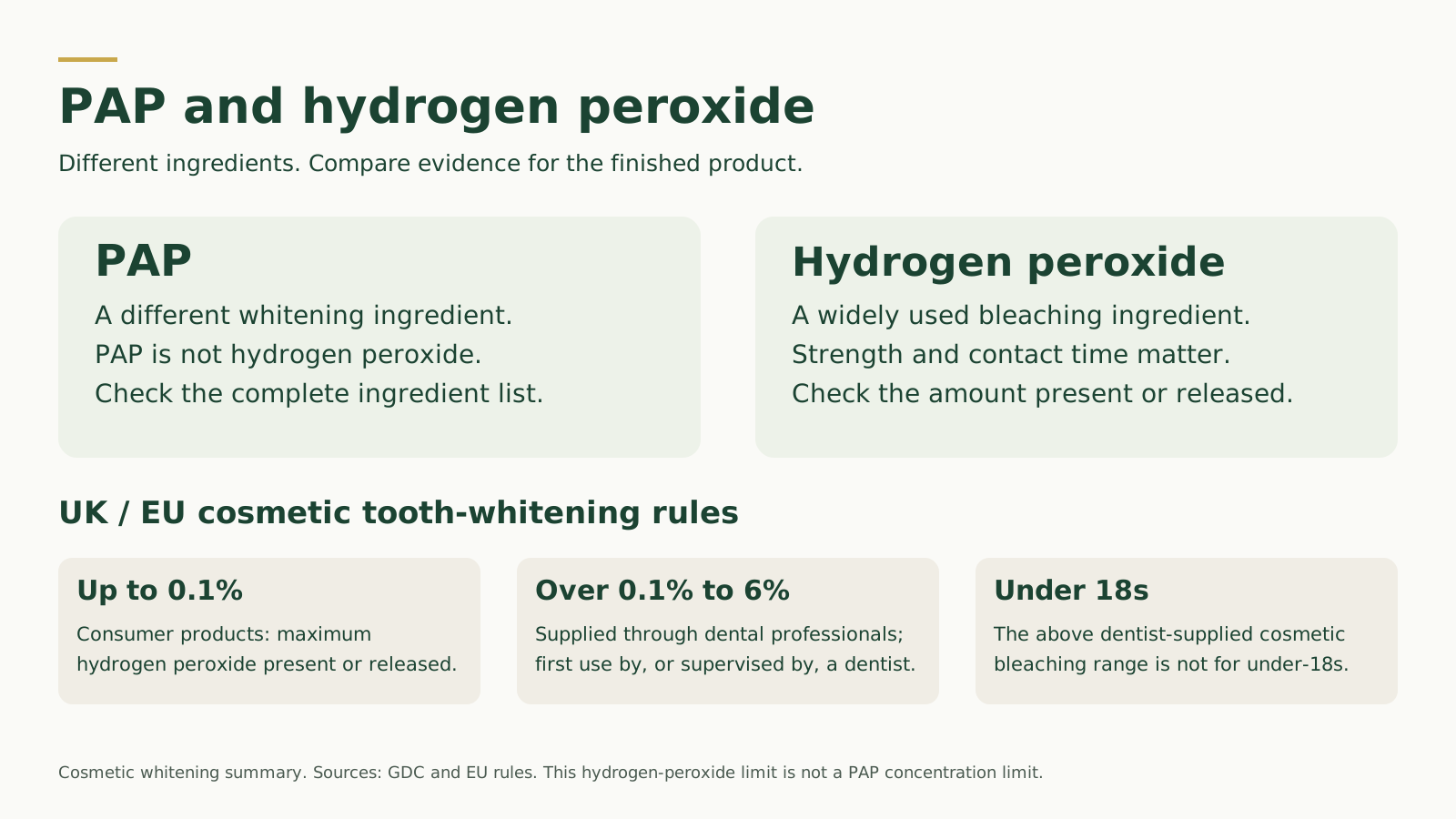
In the UK and EU, products sold to the public may contain or release no more than 0.1% hydrogen peroxide. Products from 0.1% to 6% can only be supplied through a dental professional after an examination, and not to under-18s (General Dental Council, EU Directive 2011/84/EU). So home kits sold there use PAP or very low peroxide levels.
The rules differ elsewhere. In Australia, products with up to 6% hydrogen peroxide can be sold to the public with safety warnings (Dental Board of Australia, Australian Dental Association). That is why the same brand can sell a peroxide kit in Australia and a PAP kit in the UK, as SmilePro does.
Does PAP Work? What the Research Says
The evidence is limited and mixed. Most studies so far were done in the laboratory on extracted or animal teeth rather than in people, and they disagree:
- A 2026 laboratory study on extracted human teeth (University of Valencia) found a PAP gel lightened teeth about as much as 37.5% hydrogen peroxide (a dentist-strength gel) and caused fewer changes to the enamel surface.
- A 2026 laboratory study on stained bovine enamel (State University of Campinas) found a PAP gel sold in a home LED kit did not whiten significantly more than no treatment, with or without the LED light, while 10% hydrogen peroxide did.
- A 2021 laboratory study by researchers employed by a PAP gel's maker reported that their PAP gel did not erode enamel or reduce its hardness, unlike the peroxide gels tested.
Results also depend on the exact product, its strength and how it is used, and most PAP products do not state their strength. Until there are more trials in people, it is fair to say PAP can whiten, but how much varies by product.
PAP vs Hydrogen Peroxide
| PAP | Hydrogen peroxide | |
|---|---|---|
| What it is | Phthalimidoperoxycaproic acid, a non-hydrogen-peroxide whitening agent | The bleaching agent used in dentist whitening and many home products |
| Sold to the public in the UK and EU | Yes | Only up to 0.1%; more through a dental professional |
| Sold to the public in Australia | Yes | Up to 6%, with safety warnings |
| Strength on the pack | Often not stated | Often stated (for example 6%) |
| Evidence | Limited, mostly laboratory studies, mixed results | Widely studied; the ADA describes its effects and side effects |
| Effect on enamel | Less change than peroxide in two laboratory studies; none found in a third | Changes to the enamel surface in some laboratory studies |
| Sensitivity | Not yet well studied in people | Temporary sensitivity is common, more so at higher strengths (ADA) |
Choosing a PAP Kit
Look for the strength on the pack or product page, a clear session time and course length, and a money-back guarantee. If your teeth are already sensitive, talk to a dentist first.
Our UK and EU whitening kit guide compares the PAP kits sold there, and our whitening strips comparison covers PAP strips. See also whitening with sensitive teeth.
Compare UK and EU whitening kits