Best Whitening Toothpaste (2026)
We compared the whitening toothpastes on sale in Australia, the UK and the US on what whitens, how much fluoride they contain, sensitivity ingredients and price. The same brand name can hide a different formula in each country, so pick your market below.
Top picks at a glance
- Australia: 1. Colgate Optic White Pro Series (8.5); 2. Sensodyne Daily Care + Whitening (8.3); 3. SmilePro Whitening Toothpaste (7.4)
- UK and EU: 1. Sensodyne Daily Care Gentle Whitening (8.3); 2. Colgate Max White Ultimate Radiance (7.9); 3. SmilePro Whitening Toothpaste (7.4)
- United States: 1. Colgate Optic White Pro Series (8.5); 2. Sensodyne Extra Whitening (8.1); 3. SmilePro Whitening Toothpaste (7.4)
OHA scores out of 10. Full rankings, prices and details for your market below.
Whitening toothpaste: Australia
Comparison at a glance
| Product | OHA score | Whitening agent | Fluoride | Sensitivity ingredient | Size | Price | Best for |
|---|---|---|---|---|---|---|---|
| Colgate Optic White Pro Series | 8.5/10 | 5% hydrogen peroxide | Yes (sodium monofluorophosphate) | None | 80 g | A$11.99 at Chemist Warehouse | The strongest whitening paste |
| Sensodyne Daily Care + Whitening | 8.3/10 | Stain-removing formula (agent not detailed) | 1,426 ppm | Potassium nitrate | 100 g | A$7.35 at Woolworths (sale; shelf A$10.50) | Sensitive teeth |
| SmilePro Whitening Toothpaste | 7.4/10 | Activated charcoal, baking soda, diatomaceous earth | None (fluoride-free) | None | 100 ml | A$16 | People who want a fluoride-free paste alongside a whitening kit |
| Oral-B 3D White Enamel Strong | 7.3/10 | Silica and pyrophosphate (no peroxide) | Yes (sodium fluoride) | None | 110 g | A$5.50 at Woolworths | An everyday paste on a budget |
Prices and details from each brand's site or the named retailer, checked 2 October 2026. Prices change, and several are sale prices.
#1Colgate Optic White Pro Series 8.5/10
The only paste here with a stated peroxide strength (5% hydrogen peroxide), with fluoride.
Strengths
- 5% hydrogen peroxide, stated
- Contains fluoride
- On sale at Chemist Warehouse
Limitations
- Fluoride ppm not stated on the pack
- No sensitivity ingredient
- Smaller 80 g tube
Price: A$11.99 at Chemist Warehouse. Best for: the strongest whitening paste. Skip it if: your teeth are sensitive.
#2Sensodyne Daily Care + Whitening 8.3/10
A whitening paste for sensitive teeth, with potassium nitrate and 1,426 ppm fluoride.
Strengths
- Potassium nitrate for sensitivity
- 1,426 ppm fluoride, stated
- Low price
Limitations
- Whitening agent not detailed on the brand page
- No peroxide
- Sale price may not last
Price: A$7.35 at Woolworths (sale; shelf A$10.50). Best for: sensitive teeth. Skip it if: you want peroxide whitening.
#3SmilePro Whitening Toothpaste 7.4/10
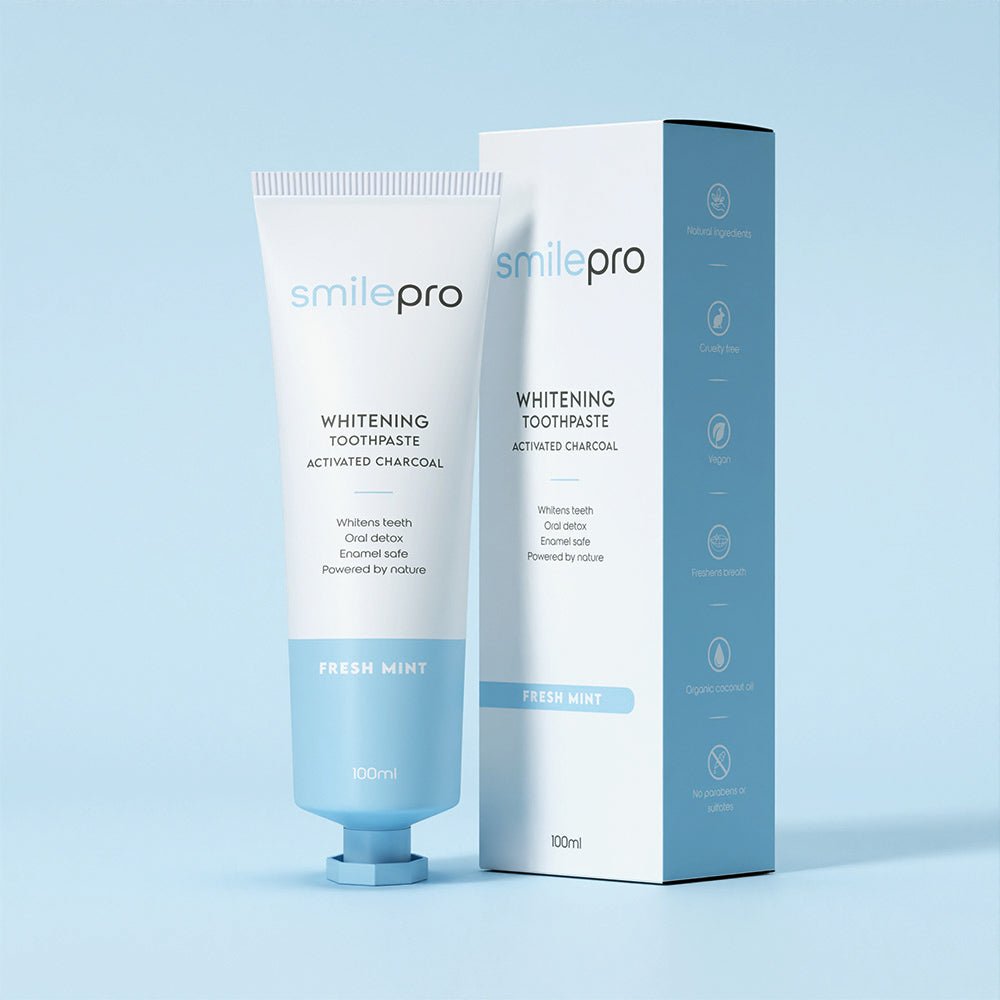
SmilePro's paste is fluoride-free and whitens by removing surface stains with activated charcoal, baking soda and diatomaceous earth. Customers rate it highly. It contains no fluoride. If you use it, use a fluoride toothpaste as well, or ask your dentist.
Strengths
- 4.8/5 from 609 reviews on SmilePro's own store
- No peroxide in the formula
- Sold as a paste to use before a whitening treatment
Limitations
- No fluoride, so it does not protect against decay
- No money-back guarantee on toothpaste
Price: A$16. Best for: people who want a fluoride-free paste alongside a whitening kit. Skip it if: you rely on toothpaste for fluoride.
Check SmilePro priceLooking for a bigger change than whitening toothpaste can give? See our whitening kit comparison for Australia.
#4Oral-B 3D White Enamel Strong 7.3/10
A low-cost everyday whitening paste with fluoride that works on surface stains.
Strengths
- Lowest price here
- Contains fluoride
- Large 110 g tube
Limitations
- No peroxide
- Fluoride ppm not stated
- No sensitivity ingredient
Price: A$5.50 at Woolworths. Best for: an everyday paste on a budget. Skip it if: you want stronger whitening.
Whitening toothpaste: UK and EU
Comparison at a glance
| Product | OHA score | Whitening agent | Fluoride | Sensitivity ingredient | Size | Price | Best for |
|---|---|---|---|---|---|---|---|
| Sensodyne Daily Care Gentle Whitening | 8.3/10 | Silica, pentasodium triphosphate (no peroxide) | 1,450 ppm | Potassium nitrate | 75 ml | £2.29 at Tesco | Sensitive teeth |
| Colgate Max White Ultimate Radiance | 7.9/10 | Potassium caroate (“active oxygen”), blue optical brightener | 1,450 ppm | None | 75 ml | £24 at Tesco (£10 with Clubcard) | The strongest UK whitening paste |
| SmilePro Whitening Toothpaste | 7.4/10 | Activated charcoal, baking soda, diatomaceous earth | None (fluoride-free) | None | 100 ml | £9 | People who want a fluoride-free paste alongside a whitening kit |
| Arm & Hammer Advanced White Pro | 7.3/10 | Baking soda, silica, pyrophosphate (no peroxide) | 1,450 ppm | None | 75 ml | £3.50 at Tesco | A baking soda paste with full-strength fluoride |
| Oral-B 3D White Arctic Fresh | 7.1/10 | Silica and pyrophosphate (no peroxide) | Yes (sodium fluoride) | None | 75 ml | £2.35 at Tesco | An everyday paste on a budget |
Prices and details from each brand's site or the named retailer, checked 2 October 2026. Prices change, and several are sale prices.
#1Sensodyne Daily Care Gentle Whitening 8.3/10
Gentle stain removal with potassium nitrate for sensitivity and 1,450 ppm fluoride, for under £3.
Strengths
- 1,450 ppm fluoride, stated
- Potassium nitrate for sensitivity
- Low price
Limitations
- No peroxide
- Surface stains only
Price: £2.29 at Tesco. Best for: sensitive teeth. Skip it if: you want the strongest whitening.
#2Colgate Max White Ultimate Radiance 7.9/10
Colgate's UK whitening paste. It is not the same formula as the Optic White Pro Series sold in Australia and the US: it uses potassium caroate, not hydrogen peroxide.
Strengths
- Potassium caroate (“active oxygen”) as the whitening agent
- 1,450 ppm fluoride, stated
- £10 with a Tesco Clubcard
Limitations
- £24 shelf price for 75 ml
- No sensitivity ingredient
- Not the peroxide formula sold in Australia and the US
Price: £24 at Tesco (£10 with Clubcard). Best for: the strongest UK whitening paste. Skip it if: price matters.
#3SmilePro Whitening Toothpaste 7.4/10
SmilePro's paste is fluoride-free and whitens by removing surface stains with activated charcoal, baking soda and diatomaceous earth. Customers rate it highly. It contains no fluoride. If you use it, use a fluoride toothpaste as well, or ask your dentist.
Strengths
- 4.8/5 from 561 reviews on SmilePro's own store
- No peroxide in the formula
- Sold as a paste to use before a whitening treatment
Limitations
- No fluoride, so it does not protect against decay
- No money-back guarantee on toothpaste
Price: £9. Best for: people who want a fluoride-free paste alongside a whitening kit. Skip it if: you rely on toothpaste for fluoride.
Check SmilePro priceLooking for a bigger change than whitening toothpaste can give? See our whitening kit comparison for UK and EU.
#4Arm & Hammer Advanced White Pro 7.3/10
A baking soda paste with 1,450 ppm fluoride. The UK formula has no peroxide, unlike the US version.
Strengths
- 1,450 ppm fluoride, stated
- Baking soda for surface stains
- Low price
Limitations
- No peroxide in the UK formula
- No sensitivity ingredient
Price: £3.50 at Tesco. Best for: a baking soda paste with full-strength fluoride. Skip it if: you want peroxide whitening.
#5Oral-B 3D White Arctic Fresh 7.1/10
A low-cost everyday whitening paste with fluoride that works on surface stains.
Strengths
- Low price
- Contains fluoride
Limitations
- No peroxide
- Fluoride ppm not stated on the listing
- No sensitivity ingredient
Price: £2.35 at Tesco. Best for: an everyday paste on a budget. Skip it if: you want stronger whitening.
Whitening toothpaste: United States
Comparison at a glance
| Product | OHA score | Whitening agent | Fluoride | Sensitivity ingredient | Size | Price | Best for |
|---|---|---|---|---|---|---|---|
| Colgate Optic White Pro Series | 8.5/10 | 5% hydrogen peroxide | Yes (sodium monofluorophosphate) | None | 3.0 oz | $8.96 at Walmart ($9.99 at Colgate) | The strongest whitening paste |
| Sensodyne Extra Whitening | 8.1/10 | Silica, pentasodium triphosphate (no peroxide) | Yes (sodium fluoride 0.24%) | Potassium nitrate 5% | 4 oz | $6.97 at Walmart | Sensitive teeth |
| SmilePro Whitening Toothpaste | 7.4/10 | Activated charcoal, baking soda, diatomaceous earth | None (fluoride-free) | None | 100 ml | $12 | People who want a fluoride-free paste alongside a whitening kit |
| Arm & Hammer Advance White Extreme Whitening | 7.3/10 | Baking soda, sodium carbonate peroxide (strength not stated) | Yes (sodium fluoride) | None | 6 oz | $3.98 at Walmart | Value |
| Crest 3D White Advanced | 7.1/10 | Silica and pyrophosphate (no peroxide) | Yes (sodium fluoride 0.243%) | None | 3.3 oz | $5.22 at Walmart | An everyday paste |
Prices and details from each brand's site or the named retailer, checked 2 October 2026. Prices change, and several are sale prices.
#1Colgate Optic White Pro Series 8.5/10
The only paste here with a stated peroxide strength (5% hydrogen peroxide), with fluoride.
Strengths
- 5% hydrogen peroxide, stated
- Contains fluoride
- Sold by Walmart and Colgate
Limitations
- Fluoride ppm not stated
- No sensitivity ingredient
- Smaller 3 oz tube
Price: $8.96 at Walmart ($9.99 at Colgate). Best for: the strongest whitening paste. Skip it if: your teeth are sensitive.
#2Sensodyne Extra Whitening 8.1/10
A whitening paste for sensitive teeth, with 5% potassium nitrate and fluoride.
Strengths
- 5% potassium nitrate for sensitivity
- Contains fluoride
- Low price
Limitations
- No peroxide
- Surface stains only
Price: $6.97 at Walmart. Best for: sensitive teeth. Skip it if: you want peroxide whitening.
#3SmilePro Whitening Toothpaste 7.4/10
SmilePro's paste is fluoride-free and whitens by removing surface stains with activated charcoal, baking soda and diatomaceous earth. Customers rate it highly. It contains no fluoride. If you use it, use a fluoride toothpaste as well, or ask your dentist.
Strengths
- 4.8/5 from 609 reviews on SmilePro's own store
- No peroxide in the formula
- Sold as a paste to use before a whitening treatment
Limitations
- No fluoride, so it does not protect against decay
- No money-back guarantee on toothpaste
Price: $12. Best for: people who want a fluoride-free paste alongside a whitening kit. Skip it if: you rely on toothpaste for fluoride.
Check SmilePro priceLooking for a bigger change than whitening toothpaste can give? See our whitening kit comparison for United States.
#4Arm & Hammer Advance White Extreme Whitening 7.3/10
A low-cost baking soda paste with a peroxide source and fluoride, in a large 6 oz tube.
Strengths
- Lowest price here
- Large 6 oz tube
- Contains fluoride
Limitations
- Peroxide strength not stated
- No sensitivity ingredient
Price: $3.98 at Walmart. Best for: value. Skip it if: your teeth are sensitive.
#5Crest 3D White Advanced 7.1/10
An everyday whitening paste with fluoride that works on surface stains. Colgate names it as the comparison for its Optic White Pro Series claim.
Strengths
- Low price
- Contains fluoride
Limitations
- No peroxide
- No sensitivity ingredient
Price: $5.22 at Walmart. Best for: an everyday paste. Skip it if: you want stronger whitening.
How we rated these products
We compared each product on four criteria: what it offers for the price, its features and formula, what customers say, and the standards it is sold under. Each gets a score out of 10, and the OHA score is their average. Our ratings are based on research using each brand's published information and customer feedback, not on hands-on testing. See our methodology disclaimer.
Buying guide
Fluoride matters most. A 2019 Cochrane review found high-certainty evidence that toothpaste with 1,000 to 1,250 ppm fluoride prevents more decay than toothpaste without fluoride. The NHS says adults should use at least 1,350 ppm. See toothpaste explained and fluoride explained.
What whitening toothpaste can do. It reduces surface stains using abrasives or low levels of peroxide. The American Dental Association says it will not make much difference to stains inside the tooth or to its natural colour. For a bigger change, compare whitening kits for Australia, the UK or the US.
Sensitive teeth. Look for potassium nitrate, which Sensodyne uses. healthdirect says whitening toothpaste can make teeth sensitive and suggests a soft toothbrush. See tooth sensitivity.
Frequently asked questions
Is whitening toothpaste safe for daily use?
healthdirect says whitening toothpaste can make teeth sensitive and advises using it with a soft toothbrush to avoid damaging enamel. If sensitivity does not settle, see your dentist.
Do I need fluoride in a whitening toothpaste?
Fluoride is what protects against decay. A fluoride-free paste, such as SmilePro's, does not give that protection, so use a fluoride toothpaste as well or ask your dentist. See toothpaste explained.
Why is the same brand different in each country?
Brands change formulas between markets. Colgate's Optic White Pro Series in Australia and the US uses 5% hydrogen peroxide; its UK whitening paste uses potassium caroate. Arm & Hammer's UK paste has no peroxide; its US paste does.
Our verdict
For whitening with fluoride, Colgate Optic White Pro Series leads in Australia and the US. In the UK, Sensodyne Gentle Whitening is the best value and suits sensitive teeth. SmilePro's paste is rated highly by its customers but has no fluoride, so it works best alongside a fluoride toothpaste, for example during a whitening course.